On Silver's Brief Instructions (1/?)
Dec. 12, 2025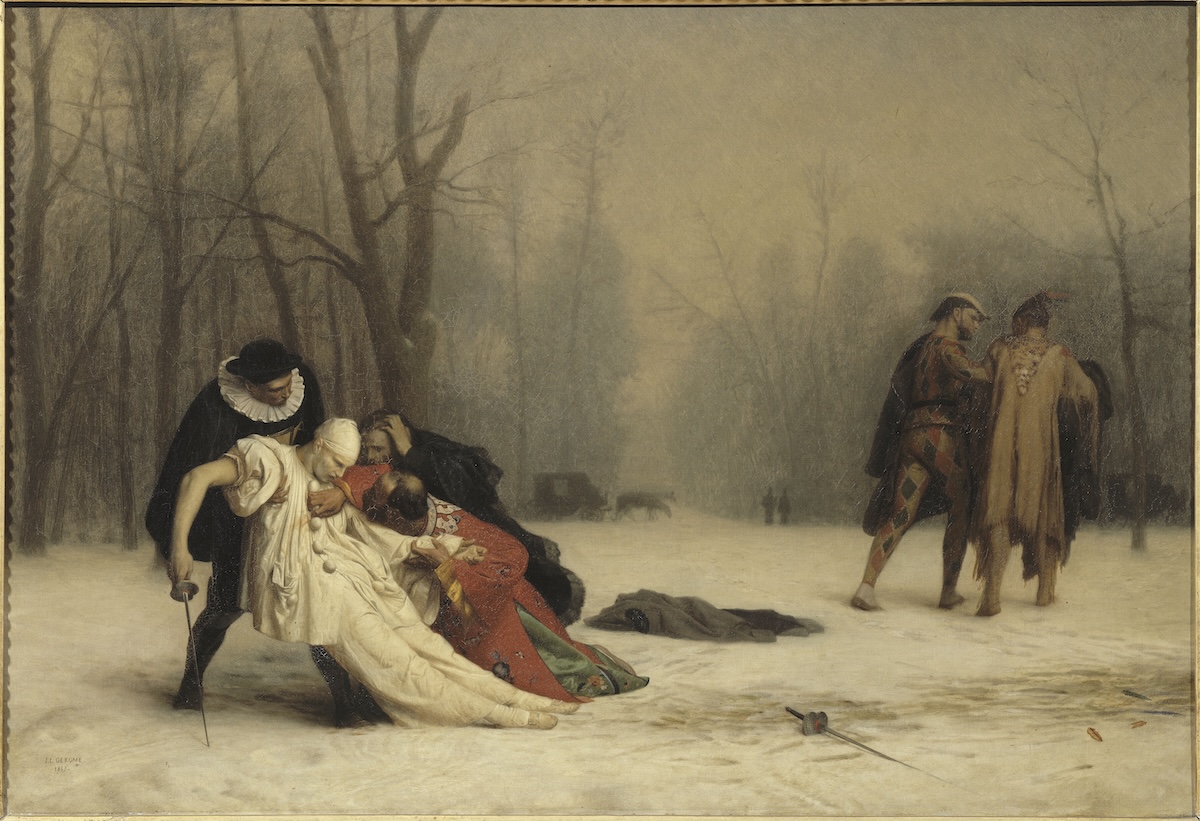 The Duel After the Masquerade by Gérôme Jean Leon
Everything written in this article is done using George Silver’s Brief Instructions as the single source, with Greg Lindahl’s transcription used for understandable quotes, but you can view a copy of the text that’s nearer to the original on the Internet Archive if you enjoy squinting and headaches.
I’m deliberately ignoring the original Paradoxes of Defense here, it’s a bit of chore to read, and somewhat an angry embarrassing mess. Like Marcion rejecting the Old Testament, followers of Silver should be lauding the clear, rules-based methodology of the later Brief Instructions and shunning of the polemic Paradoxes of Defense. Brief Instructions existing at all hints that even Silver understood his original work was pretty cryptic and his later adoption of manualistic style hints that he knew also the original was a bit rubbish for teaching anything.
There is good in Paradoxes, but even that stuff is a bit longwinded.
Anyway, here I’ll cover a few points on Silver that cause some disagreement in my local scene, using Brief Instructions as the basis; I’ll cover Holding the sword, which foot goes forward & discouraging grabs and grappling.
Holding The Sword
From my reading, Silver is pretty explicit in his description of essentially a trigger grip being his preferred grip, with the index finger pointing forward, relying on the back three fingers for grip. Silver was a trigger grip guy.
Of the short sword & dagger fight against the long sword & dagger or long rapier & poniard.
(28.) Remember in putting forth your sword point to make your space narrow, when he lies upon his Stocata, or any thrust, you must hold the handle thereof as it were along your hand, resting the pommel thereof in the hollow part of the middle of the heel of your hand towards the wrist, & the former part of the handle must be held between the forefinger & thumb, without the middle joint of the forefinger towards the top thereof, holding that finger somewhat straight out gripping round your handle with your other 3 fingers, & laying your thumb straight towards his, the better to be able to perform this action perfectly, for if you grip your handle close out-thwart in your hand, then you cannot lay your point straight upon his to make your space narrow, but that your point will still lie too wide to do the same in due time, & this is the best way to hold your sword in all kinds of variable fight.
Out-thwart is an ugly way of saying outright, he’s saying don’t use hammer grip. It’s only afterward does he say to do hammer grip and only in specific circumstance:
But upon your guardant or open fight then hold it with full gripping it in your hand, & not laying your thumb along the handle, as some use, then shall you never be able to strongly to ward a strong blow.
Which Foot Forward?
Some single sword schools unusually do left foot forward for Silver’s system, which has always struck me as a bit odd. You’re making yourself present a wider portion of yourself to your foe & bringing all of your body to equal nearness. While right foot forward presents one edge of yourself closest out of necessity and every other part increasingly further away, without drawing your weapon any more distant than a left footed stance would. I’m assuming right handedness here.
Anyway, right foot forwards seems to be Silver’s operative default, or the only mentioned static stance in Brief Instructions. It is at least described as the chiefest of the variable fights: Stocata, “which is to lie with your right leg forward” and later reiterated upon.
Variable fight is all other manner of lying not here before spoken of, whereof these 4 that follow are the chiefest of them.
(1) Stocata: which is to lie with your right leg forward, with your sword or rapier hilt back on the outside of your right thigh with your point forward to ward your enemy, with your dagger in your hand extending your hand towards the point of your rapier, holding your dagger with the point upright with narrow space between your rapier blade, & the nails of your dagger hand, keeping your rapier point back behind your dagger hand if possible.
Under the same list, Silver does mention having your left foot forward, but only during the passage of motion;
(4) Passata: is either to pass with the Stocata, or to carry your sword or rapier hilt by your right flank, with your point directly against your enemy’s belly, with your left foot forward, extending forth your dagger forward as you do your sword, with narrow space between your sword & dagger blade, & so make your passage upon him.
The Brief Instructions continues to mandate the right foot forward when the fencer is pressing the attack from Variable Measure:
Of the short sword & dagger fight against the long sword & dagger or long rapier & poniard.
(14.) If he lies upon his Stocata, with his rapier point within or behind his dagger hand out straight, then lie upon variable in measure with your right foot before & your sword point out directly with your space very narrow as near his rapier point as you may, between his rapier point & his dagger hand, from which you may suddenly with a wrist blow, lift up your point & strike him on the outside or inside of his dagger hand, & fly out withal, then make your space narrow as before, then if he thrust home at you, you are already prepared for his thrust, or you may thrust at his dagger hand, doing which you may think best, but your blow must be only by moving your wrist, for if you lift up your hand & arm to fetch a large blow then your time will be too long, & your space to wide in due time to make a true ward to defend yourself from his thrust, so shall you hurt him although he has a gauntlet thereon, for your thrust will run up between his fingers, & your blow will cut off the fingers of his gauntlet, for he cannot defend himself from one blow or thrust of 20, by reason that you have the place to reach home at his hand, & for that cause he cannot prevent it, neither can he reach home to you without putting in his foot or feet, because the distance is too large, but upon every blow or thrust that you make at his hand slip back a little, so you shall still upon every blow or thrust that you make at him, be out of his reach.
Sword Grabbing & Wrestling Discouraged
Sword grabbing and wrestling has an outsized existence in the teachings of Silver, despite the guy pretty explicitly stating it’ll probably get you killed and should only be used as a last resort, if you’re getting jumped yourself or if your foe is really falling to bits.
He’s pretty explicit here:
Of the short single sword fight against the like weapon.
(26.) Do you never attempt to close or come to grip at these weapons unless it be upon the slow motion or disorder of your enemy, But if he will close with you, then you may take the grip of him safely at his coming in, for he that first by strong pressing in adventures the close looses it, & is in great danger, by reason that the number of his feet are too great, whereby his time will be too long, in due time to answer the hand of the patient agent, as in the chapter of the grip does plainly appear.
And here:
Of the short sword & dagger fight against the like weapon
(6.) You must neither close nor come to the grip at these weapons, unless it is by the slow motion or disorder of your adversary, yet if he attempts to close, or to come to the grip with you, then you may safely close & hurt him with your dagger or buckler & go free yourself, but fly out according to your governors & thereby you shall put him from his attempted close, but see you stay not at any time within distance, but in due time fly back or hazard to be hurt, because the swift motion of the hand being within distance will deceive the eye, whereby you shall not be able to judge in due time to make a true ward, of this you may see more in the chapter of the back sword fight in the 12th ground of the same.
And here:
The manner of certain grips & closes to be used at the single short sword fight, etc.
(7.) Remember that you never attempt the close nor grip but look to his slip, consider what is said in the 8th general rule in the second chapter, & also in the 26th ground of the single sword fight in the 4th chapter.
For context on those references he makes, first here is the 8th general rule in the second chapter.
(8.) Look to the grip of your enemy, & upon his slip take such ward as shall best fit your hand, from which ward strike or thrust, still remembering your governors.
And the 26th ground of the single sword fight in the 4th chapter, again.
(26.) Do you never attempt to close or come to grip at these weapons unless it be upon the slow motion or disorder of your enemy
Silver doesn’t use the word never much in the instructional section of the text, but when he does it tends to be telling you not to close or grip outside of very specific circumstances. When those circumstances are met, he’s pretty clear that he wants you to do get it over with quickly and return to a good distance asap, and not do extended sequences of grapples.
Unwillingly into the abyss
I’m not a fan of reading Silver, his pub bore schtick get old comically fast, but the points I’m trying to make here are to try and combat some interpretations that have been bothering me pretty frequently of late, enough to suffer reading him again.
Hopefully I’ve kept my own interpretations minimal enough to not get hoisted up on them, I’m just trying to present things plainly, so I’ve leaned heavily on quotes instead. Anything further I do write on Silver will be done here, I won’t be posting on any of the various Silver forums blighting the web, I value my sanity and time.
This is probably one of many Silver focused posts.