Dec. 12, 2025
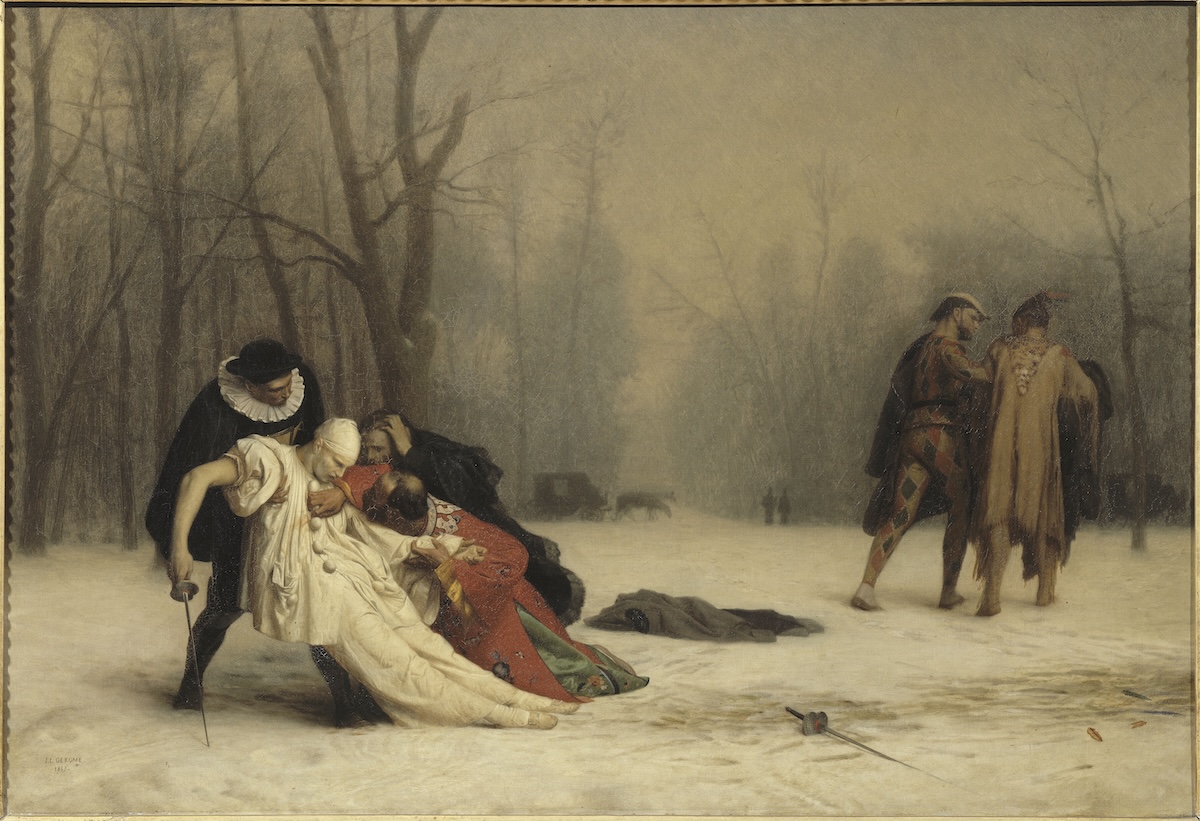 The Duel After the Masquerade by Gérôme Jean Leon
Everything written in this article is done using George Silver’s Brief Instructions as the single source, with Greg Lindahl’s transcription used for understandable quotes, but you can view a copy of the text that’s nearer to the original on the Internet Archive if you enjoy squinting and headaches.
I’m deliberately ignoring the original Paradoxes of Defense here, it’s a bit of chore to read, and somewhat an angry embarrassing mess. Like Marcion rejecting the Old Testament, followers of Silver should be lauding the clear, rules-based methodology of the later Brief Instructions and shunning of the polemic Paradoxes of Defense. Brief Instructions existing at all hints that even Silver understood his original work was pretty cryptic and his later adoption of manualistic style hints that he knew also the original was a bit rubbish for teaching anything.
More…
Jul. 2, 2024
There is not as far as I’m aware a common, system agnostic, simple textual notation for fencing; moves that can be written without advanced ligatures or illustrations. There’s a pretty extensive history of written notation for dance, which in terms of motion is fairly close to fencing, but none besides Labanotation (which is used by the US for the copyright of dance) have significantly caught on and endured in history. Dance/Movement notation is a relatively niche field and jam-packed with advanced symbols and flexible geometry. Without resorting to clunky spoken language, it’s tough to describe a sequence of bodily movements quickly, casually and succinctly in non-graphical form.
More…
May. 22, 2024
Revisiting my post about solving the opposing face of various dice configurations I pondered how a “left handed” turned dice might work. Say rather than placing five and six at the top and bottom of the dice, what if the medieval maker placed one and two in their place, then spiralling around the outside, three, four, five, six? Can we leverage our previous monster of an equation to solve it?
More…
Jan. 2, 2024
The 1991 Dangerous Dogs Act has hit the news again as “XL Bully” (a type of Pit-Bull cross), becomes officially banned in England & Wales. Bully enthusiasts nationwide had been convinced that at the stroke of midnight, thousands of Bullies would be euthanised at once by complicit kennels and dog-catchers.
Maybe, if the Act had any real bite.
Those dogs spared the hand of Death will instead live out their days muzzled, neutered (like most dogs), microchipped (like most dogs) and always leashed when in public (like most dogs). These banned bullies must be registered on an “Index of Exempted Dogs“, shall not be gifted, sold or bred, and err, that’s about it. Most of these restrictions are already followed as-norm by responsible dog owners.
More…
Dec. 28, 2023
January’s issue of the History Today has a great article on the creation and changing attitudes of the KGB after Stalin’s death. One fact which leapt out was the large number of persons being followed by the KGB in 1967; almost 6,750, according to a leaked report.
That sounds an awful lot, but is it?
By 1967 the population of the USSR was almost 241,720,000 (the rough figure for 1970), 6,750 people is just 0.000028% of the population, or 7 in 25,000,000 people being followed.
More…
Dec. 26, 2023
Wikipedia’s flag for Russia 1991 – 1993 has had a decade long edit war, with 58 revisions over which colours should be used.
Some editors are convinced that the colours for the Russian flag in those years was brighter than today’s darker toned flag. Other’s aren’t so convinced, and believe the tones have always been the current darker variant. There’s confusing evidence and usage of both. There’s also a third set of tones which appear to match darker evening variants of the colours, though this kind is seen less often.
More…
Jan. 19, 2023
Sometime shortly before January 24, 1919, the A.G. Spalding Brothers Company developed fencing masks for the U.S. Government. Two masks are recorded in the National Archives, one for infantry and one cavalry, a front and side view is presented for each.
Curiously it is the cavalry mask which bears the best resemblance to the modern fencing masks we’re familiar with nowadays. It also offers the best protection, while contrastingly the infantry mask offers better visual fidelity – at expense of eye cover.
More…
Dec. 10, 2022
Below is a hand-digitisation of the New York Times article reporting the outlawing of lobotomies by the Soviet Union in the 1950s.
The United States and Europeans continued the practice for decades after, as late as 1980 in France.
The history of Mental Health institutions, or asylums, are a keen interest of mine and I’ll be posting more with regards to them in future. The artist Louis Wain, who’s artwork is used for the site logo (the two fencing cats), and other artwork around the site was himself sadly a patient of several mental hospitals.
More…
.svg&limit=500)